
Ova and Parasites, Stool
Test Code: 681
CPT Code(s): 87177, 87209
Clinical Significance: Diseases caused by human parasites remain on a worldwide basis among the principle causes of morbidity and mortality. Correct diagnosis of intestinal parasitic infection depends on proper collection, transport, detection and identification of parasites in stool specimens. Symptoms range from malaise to death. Treatment is dependent upon examining multiple stool specimens due to the erratic shed rates of some parasites.
Includes: Ova and Parasite Concentrate Result, Trichrome Result
Methodology: Microscopic Examination of Concentrate • Permanent Stained Smear
Alternative Name(s): O and P with Permanent Stain
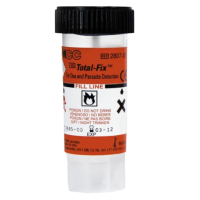
Supply: #F01 Total-Fix® Transport Vial or #U02 90mL Sterile Cup with Green lid (for urine or sputum)
Patient Preparation: Interfering substances: Bismuth, barium (wait 7-10 days), antimicrobial agents (wait 2 weeks), gallbladder dye (wait 3 weeks after procedure)
Preferred Specimen: 10 grams or 10 mL fresh stool preserved in 1 single Total-Fix® transport vial or 10% formalin and polyvinyl alcohol transport vials
Collection Instructions: Note: Tissue samples should be sent to pathology.
Stool: Place fresh stool in a single Total-Fix transport vial or 10% formalin transport vial, as well as PVA transport medium, within 30 minutes of collection. Add stool to bring the liquid level to the "fill to here" line on the vial. Mix well. Send specimen(s) at room temperature in the same shipping container.
If parasite infestation is strongly suspected, collect at least 3 stool specimens every other day, since a single specimen can be negative. If Giardia is strongly suspected, please see Giardia Antigen, EIA, Stool, Test Code 8625.
Urine: Urine may be submitted unpreserved for exam for Schistosoma. Collect at mid-day. Peak egg secretion occurs between noon and 3 p.m. Do not submit first morning specimen. In patients with hematuria, eggs may be found trapped in blood and mucous in the terminal portion (last-voided portion) of the urine specimen. Trichrome Stain is not performed on non-stool samples.
Sputum: The specimen should be a deep expectorated sputum, preferably collected in the early morning. A 24-hour sputum collection is also acceptable. Submit in a sterile screw-cap container, unpreserved or in 10% formalin to increase stability. Trichrome Stain is not performed on non-stool samples.
Transport container: Total-Fix transport vial
10% formalin and polyvinyl alcohol transport vials
Urine submitted in a sterile screw-cap container
Sputum or BAL submitted in a sterile screw-cap container or with 10% formalin
- Stool, sputum, and BAL (preserved): Room temperature
- Urine, sputum, and BAL (unpreserved): Refrigerated (cold packs)
- Stool (preserved)
Room temperature: 30 days
Refrigerated: 30 days
Frozen: Unacceptable - Urine, Sputum, BAL (unpreserved)
Room temperature: Unacceptable
Refrigerated: 48 hours
Frozen: Unacceptable - Sputum, BAL (preserved)
Room temperature: 30 days
Refrigerated: 30 days
Frozen: Unacceptable
- Unpreserved stool
- Specimens containing barium
- Stool preserved in medium other than those listed as acceptable
- Preserved urine
- Liver abscess or aspirate
For additional supply or collection information, please contact DLO's Customer Service at (800) 891-2917, option 2.
The CPT codes provided are based on AMA guidelines and are for informational purposes only. CPT coding is the sole responsibility of the billing party. Please direct any questions regarding coding to the payor being billed.